Why Play Kakuro? 11 Science-Backed Benefits
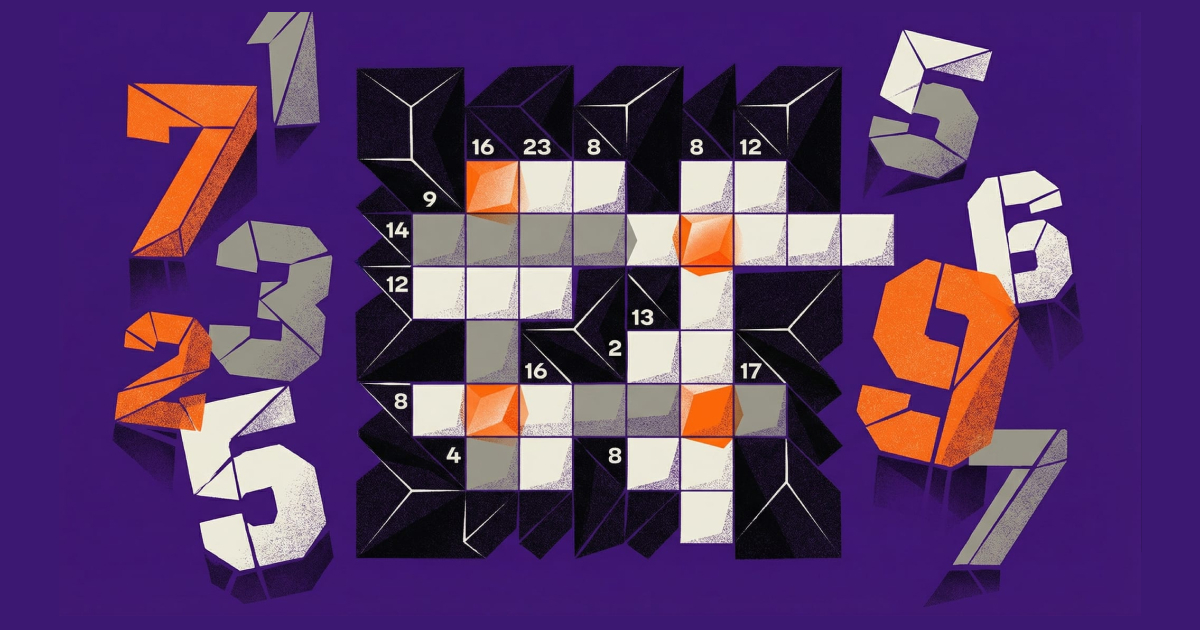
Kakuro looks intimidating — a grid of numbers with no instructions in sight. But once you understand the rules, it's one of the most satisfying puzzles you can play. This guide breaks down what it is, why it's worth your time, and who it's actually best for.
What is Kakuro? Why is it so popular and how does it improve your cognitive skills? Continue reading to find out!
What is Kakuro?
A Kakuro puzzle is like a crossword that swapped words for numbers. You’ve got a grid with black cells that show clues, each one called a "sum clue". The white cells, on the other hand, are where you place digits from 1 to 9, and the numbers in each row or column have to add up exactly to the clue.
The catch is you can’t repeat a digit within the same row or column. So if the clue says 16 across three cells, you’re juggling combos like 9‑6‑1 or 7‑5‑4, then cross‑checking with the vertical sums to see what actually fits.
So if we were to further simplify it, Kakuro is more like an addition-centric mix between a crossword and a Sudoku puzzle.
Never played before? Our beginner's guide to how to play Kakuro walks you through the grid, the rules, and your first solve.
Why people should be playing Kakuro puzzles
If you've read this far, then you must probably have already seen Kakuro puzzles, and you wonder how anyone could solve a puzzle like this. “It must take a genius,” you think. And while having above-average math ability certainly helps, it certainly isn't a necessary component for success.
In fact, Kakuro doesn’t require any sort of outstanding intellect at all. Rather, it simply requires elementary math skills and a willingness to think about and solve problems. It’s so simple a baby could do it. Well, maybe not a baby, but an elementary school-aged child could, at least. Could and should.
Why?
Here's the thing: Kakuro isn't just accessible, it's also entertaining and provides many cognitive benefits.
The cognitive benefits of Kakuro
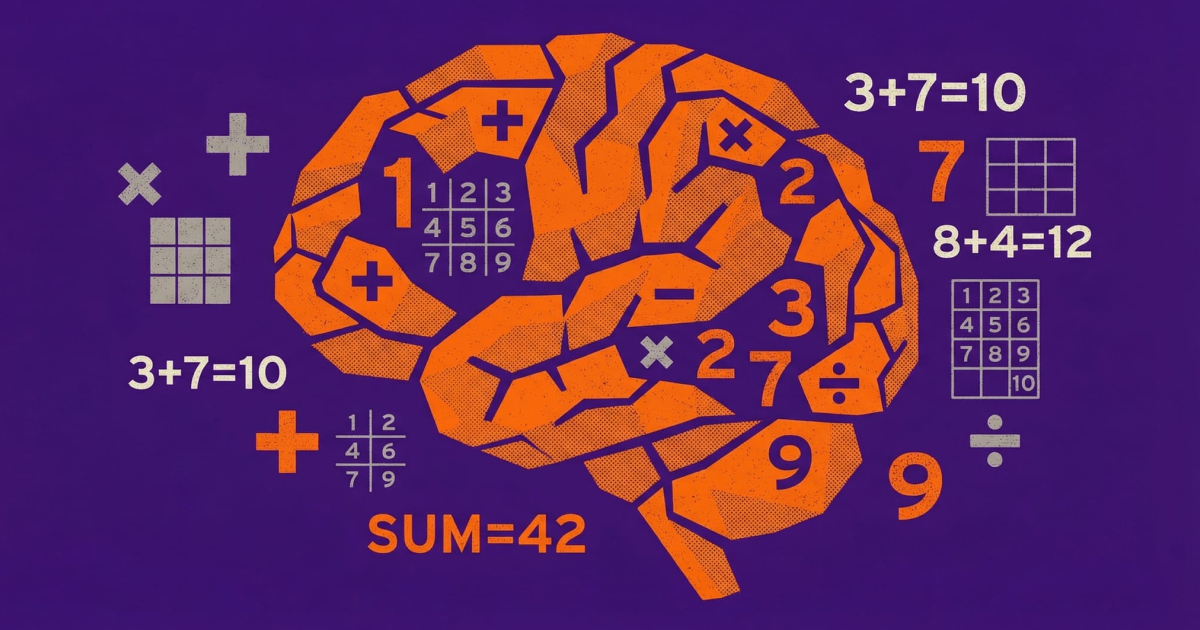
See, most grid-type puzzles offer some form of mental boost when properly played and analyzed. Not all of them offer the same benefits, but most, if not all of them, help improve the mind in learning and improving.
However, if you're thinking that playing complex puzzles alone will make you the next Einstein, you should get that out of your head immediately.
It's a common misconception: solving puzzles and sharpening logical thinking don't directly make you smarter.
Rather, using your problem-solving skills, especially in logic puzzles, helps make your brain active and engaged, which then turns the process of learning better and faster.
If you enjoy number-based brain training, Sumplete is another arithmetic elimination puzzle worth trying alongside Kakuro.
1. Rapid "gym" for math skills and number skills
Kakuro demands actual calculation. You’re constantly adding, subtracting and eliminating possibilities. This repeated arithmetic practice improves speed and accuracy with numbers, which translates into better everyday math skills, according to this study.
Just like the muscles on your limbs, constantly using your mind in a specific way (and in this case, for arithmetic and number sense) makes it perform better overall. Kakuro acts as the "gym" where your mind can get the mental workout it needs in a fun way.
For a faster daily math fix, Mathler is a free equation-guessing game that trains the same arithmetic skills in under 5 minutes
2. Working memory booster
Every clue requires you to hold possible number sets in mind while cross‑checking with intersecting rows or columns. That’s working memory in action, and repeated practice strengthens it. This research notes that puzzles stimulate synaptic connections and improve cognitive functions by forcing players to fill in missing pieces within a rule‑bound system.
To give a familiar analogy, you know those times when your brain just automatically completes words that you already know? For example, if we put out A P _ L E, your mind just immediately fills the blank with a P, turning it into APPLE. That's similar to how your brain completes the few remaining holes in a Kakuro puzzle while following the rules.
Why?
Because it's the word that's been drilled into your mind since childhood, and in Kakuro's case, that's number sense and working memory acting in tandem.
3. Pattern recognition & logical thinking
Kakuro has you thinking about multiple number combinations under constraints. This kind of structured problem‑solving enhances executive function—the brain’s ability to plan, strategize and adapt. This academic research highlights how puzzles like Kakuro sharpen critical thinking and pattern recognition.
While it's true that Kakuro is primarily an arithmetic logic puzzle that can be solved by an absolute beginner, experienced Kakuro players have completed so many puzzles that they already notice patterns in every single grid they hold.
For example, one glance at an intersection that has a high sum on one side and a low one on the other, and they already know that a 9 and a 1 are involved. Pair that with number skills, and they just go to town and solve the puzzle in less than ten minutes.
4. Focus, flow and calm
Like most puzzle games, Kakuro, once you get the hang of it, has a recognizable gameplay flow. To many players who have continuously solved Kakuro puzzles, the process can be very therapeutic. The moment you get that first number clue right is when the other numbers just start falling into place.
Kakuro requires sustained concentration to avoid repeating digits and to track overlapping sums. Studies on puzzle games show they promote immersive learning and attentional control, keeping the brain locked in on the task.
Your mind then enters a kind of flow state, where you systematically dismantle the puzzle from the points that make the most sense to you. You logically go from point to point, then let instinct guide the rest up to the point you submit your results.
Once you’ve played the game yourself and solved your own puzzles a few times, you’ll definitely understand the satisfaction of seeing blank cells and knowing exactly what to do when it just clicks in your head. This sense of knowing and success is also why most number puzzles like Kakuro continue to have their diehard communities.
5. Difficulty scales with you
Not all brainy games scale properly with their players, which makes Kakuro different from others. Need an example? Basic matching games, in particular, don't scale well over time. It's a pretty hot take, yes, but we can explain why:
Basic memory matching games often just add more cards or items on the screen or board to match and scramble, while the contents don't change. Sure, there's more to work with, but it doesn't add a new cognitive skill to use and polish in there. Instead of fun and challenge, the matching game turns into a boring chore.
In Kakuro's case, the size of the grid is relative to its difficulty, where larger actually means harder. Unlike our previous example, bigger grids have more numbers in them. That means more digits, more arithmetic, more challenge. And when you start with the smaller grids, then gradually make your way up, the gameplay experience is more notable.
Difficulty scaling is important in providing a sense of accomplishment and improvement, which then boosts the mood of the player, which ultimately leads to improved cognitive skills and performance.
6. Portable & accessible entertainment
It is true that most devices nowadays have built-in apps, but most of them often need an internet or data connection to function properly. One of the biggest benefits of Kakuro is that it was originally a physical sheet puzzle, so all of them work perfectly when printed.
Not only that, but even the digital ones often still work as long as the puzzles were loaded properly before the connection gets cut. Though if you're planning to bring Kakuro puzzles on a long trip with spotty connection, the ideal way is to print your sheets beforehand and pack them safely.
7. Great for classrooms
Kakuro is one of the best ways to incorporate a fun activity into your math lesson plan, especially among younger learners (ages 8-15). There are many ways to have the entire classroom participate, from printing handouts one by one for a more hands-on experience to projecting the puzzle onto a whiteboard for groups to solve.
Interestingly, most school firewalls tend to allow access to educational puzzle websites, so playing Kakuro in a computer lab activity is also very possible. We'll discuss more about using Kakuro in school down below, so keep reading!
8. Highly accessible
Not all puzzles can boast that they are accessible, but Kakuro definitely can. Because of its easy-to-understand gameplay mechanics and very simple graphics, Kakuro retains its mass appeal to a wide demographic range. It's very light on digital resources, and is cheap to print if you prefer a more tactile experience.
Not only that, but its adjustable difficulty and grid sizes, as well as other accessibility features like extra zoom in or extra large fonts, make it an ideal game for everyone to try. There's also no big language barrier, unlike with most word games, since numbers work the same way whether you're from the North Pole or a suburb in New Jersey.
9. Senior-friendly mental engagement
Kakuro is one of the best puzzles for older folks. It's simple, minimalistic and engaging, making it an ideal form of entertainment for senior-aged players. Old people have a hard time keeping up with all the new and flashy games of the youth, but with Kakuro puzzles, they can take their time enjoying and also keep their mind active, which is key to preventing neurological conditions like Alzheimer's.
There are other factors as to why this puzzle is best for senior players—learn more about them in our Kakuro for seniors article.
10. Supports emotional and brain health
Puzzle games are what they are because of the challenge they bring, and they give dopamine differently than games like Call of Duty or Fortnite. Kakuro doesn’t hand you easy wins. It teaches you to tolerate frustration, backtrack and try new strategies. That persistence is a cognitive skill in itself, linked to improved problem‑solving skills, especially in learning contexts.
Aside from keeping your brain healthy and active, solving Kakuro puzzles also greatly improves your mood with every win, shooting dopamine in your system with every success. A positive mood leads to better overall health and enhanced learning capability.
11. Social & community
As we've already discussed earlier, puzzle games like Kakuro often have long-standing communities. Fan groups of the game openly welcome new members to discuss their love of the game with, as well as teach and learn alongside, like in this puzzle game Discord server.
For the more competitive players, leaderboards are also a healthy way to promote friendly rivalry among other passionate Kakuro solvers. More often than not, digital Kakuro rivalries and competitions pave the way to real-world social interactions and friendships.
Why Kakuro logic puzzles are great for learning
Just like Solitaire and other classic pastimes, Kakuro is a great puzzle to play for both recreational and educational purposes. It’s entertaining, engaging and mind-stimulating with its unique take on the logic principles of Sudoku and other similar grid-based number puzzles. With how it works, one can wonder: “Can I use Kakuro puzzles in a classroom domain?”
Of course, you can! Challenging learners and new users with combinations of logic and math is a good way to improve an educational setting.
Here are several reasons why you should consider implementing the game into your classroom routine!
✅ It piques the interest of students
Regardless of the age of your students, pulling out a Kakuro puzzle instead of the usual picture book or a syllabus can easily gain their attention. Kakuro and kids' learning often work well because gamified supplemental lessons make the whole process more interesting for them. Sure, it’s important to stick to tried and tested lesson plans, but keeping things fresh with something different yet effective lessens the cage-like monotony involved in institutional learning.
Average students are known to get bored and doze away in lessons that don’t pique their interest; that’s why many of them end up excelling in fields they actually like, such as sports or performing arts. Math is already a hard subject to engage students with, especially when there are a lot of digits on the board. But with Kakuro serving as a reinforcement, it can become a lot easier to hook students in.
✅ It’s useful in improving logical thinking and arithmetic
Kakuro puzzles are great for improving the arithmetic and logical thinking skills of younger students. However, keep in mind that they need to be able to comprehend all the mechanics of the game first and that they can use addition and subtraction to an acceptable level.
Forcing children to play Kakuro when they can’t add up to at least hundreds is not going to be effective, nor is using Kakuro alone as your main source of basic addition and subtraction. When properly implemented, younger students can become more attuned to logic as they continuously play Kakuro, and their mental calculation becomes sharper!
✅ It’s easy and cheap to incorporate into your lesson plan
Unlike other game-related learning materials, which usually involve the usage of complex devices or workstations (and even sometimes combinations of both), Kakuro doesn’t need that much.
You just need reference puzzles, pieces of paper and a pen or pencil to write lines and digits with!
We highly recommend printing a large set of Kakuro puzzles, with each being different from one another, if you’re planning to have it work as a supplementary lesson or as extra credit homework. You can even encourage them to play online Kakuro puzzles through their devices!
✅ It's nigh-infinite and free
Just like the logic of Sudoku, there are just too many possible combinations of Kakuro puzzles, making it nigh-infinite and impossible to finish even in hundreds of lifetimes. Cage size, different possibilities, changing the given sum, there are many variations you can play around with, especially if you're creating your own Kakuro puzzle or via online Kakuro puzzle generators.
This is definitely a good thing in a classroom setting, as you could go through the whole academic year with a unique Kakuro puzzle every day for every student in the room without any repetitions.
Moreover, Kakuro is free-to-play on many websites! From server to server, loads of free Kakuro games and reference sheets are available for online play or downloading. And because of its simplicity, the load time for any device is not a problem.
When is Kakuro not ideal to play?
Like with most things, everybody has their own preferences, and that remains a fact even with puzzle games. Many people like Kakuro, many people don't, and based on our experience, these are the scenarios when Kakuro isn't an ideal recommendation:
❌ When you want a quick, light puzzle
Kakuro grids often take longer to solve because you’re juggling sums, possible number sets and cross‑checking rows and columns. If you’ve only got five minutes, a Crosswordle 7x7 or Mini Sudoku for a quick 6×6 logic fix.
❌ When you’re mentally fatigued
Because Kakuro relies heavily on arithmetic and logical deduction, it’s not the best game to play if you’re already tired or stressed. The puzzle demands working memory and focus, and playing it while drained can feel more frustrating than fun, especially if you're playing on higher difficulties.
❌ When you dislike math‑based puzzles
Kakuro is essentially arithmetic wrapped in a crossword format. If numbers aren’t your thing, or if math anxiety kicks in, the puzzle can feel like homework rather than play.
❌ When you’re seeking creative or word‑based play
Crosswords let you flex vocabulary, trivia and cultural knowledge. Kakuro strips all that away—it’s purely numbers. If you’re craving wordplay or storytelling, Kakuro won’t scratch that itch. We do, however, have these other games that will definitely satisfy your needs:
Play Crosswordle, a modern, hybrid crossword puzzle →
Play Pair Down, a hidden word game →
Play Squeezy, a letter-insertion word game →
FAQs
Is Kakuro good for your brain?
Yes — multiple studies link arithmetic puzzle play to improved working memory, pattern recognition, and focus. The no-repeat digit rule forces logical deduction, not just memorization.
Is Kakuro harder than Sudoku?
Yes. Kakuro basically combines the challenging aspects of both crosswords and Sudoku and adds a core math element to it, making it harder in general in all difficulties than Sudoku.
How long does a beginner puzzle take?
It depends on the grid size and difficulty. The average player playing a 4x4 easy Kakuro puzzle usually takes around five minutes, so larger grids, even on the easiest difficulty, will need more than five minutes at least.
Is Kakuro good for kids/seniors?
Definitely! We highly recommend them for kids to supplement their learning curriculum, while they're ideal for maintaining cognitive sharpness for seniors.
Do I need math beyond basic addition?
Yes. You'll also need basic subtraction when you start putting multiple numbers on rows and columns.
Play Kakuro and other puzzles today!
We hope that we were able to tell you what Kakuro is and why you should start playing it. If you're interested in more complex puzzles, we highly recommend that you check out our website for other games that might pique your interest.
Go to Hey, Good Game, home of your indie brainy games →
If you're interested in more insightful content like this, subscribe to our newsletter to get fresh game ideas and info every week!
 Mini Crossword
 Midi Crossword
 Diffle
 Killer Sudoku
 Numberle