How to Play Kakuro: The Complete Beginner's Guide (Rules, Grid + Strategies)
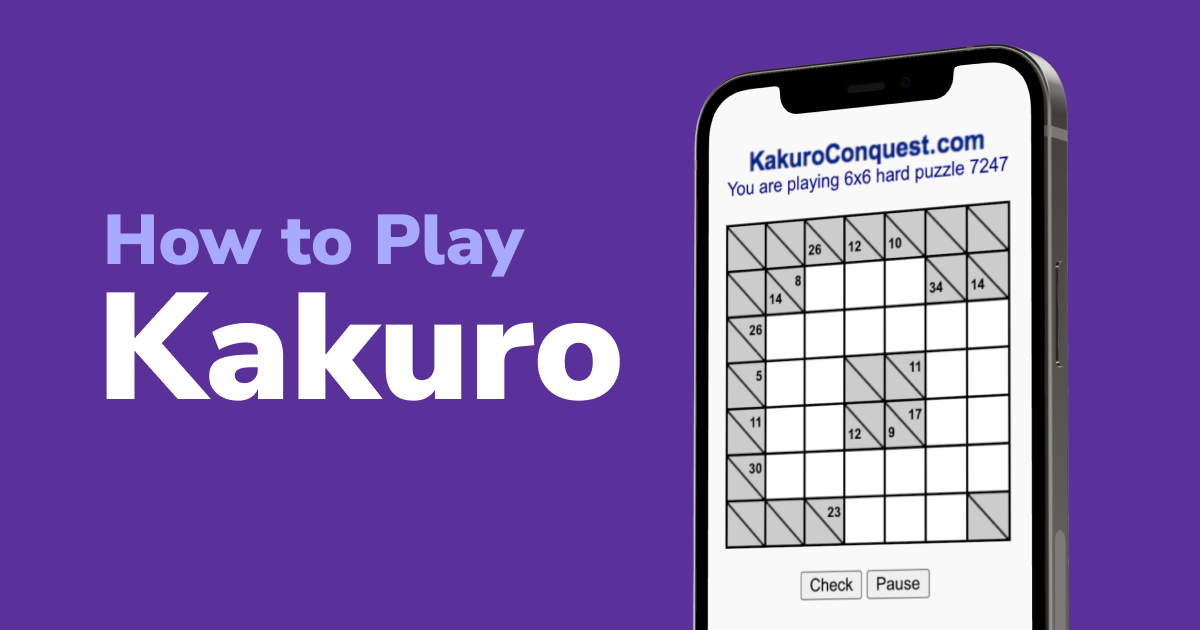
An Introduction to Kakuro
Kakuro puzzles look like a crossword puzzle, but they play a bit more like Sudoku. Instead of letters, players must fill the board with numbers whose sums match clue numbers, rather than a crossword’s word clues.
Solving Kakuro puzzles requires no advanced math — just basic addition and logical deduction. Most people can pick up Kakuro puzzles in under 10 minutes.
What this guide covers:
- How Kakuro works and what the grid means
- The rules of Kakuro (they’re simpler than they look, we promise)
- How to read a clue and complete a run
- Beginner strategies to help solve your first puzzle
- What to do when you get stuck
What Is Kakuro?
Kakuro is a number crossword puzzle that challenges players to complete groupings of cells known as “runs” with the numbers 1-9 (with no repeats) so that each run adds up to the corresponding sum.
Each empty square must be filled with a number between 1 and 9 that contributes to its run's sum.
Each puzzle has exactly one solution, making it important to carefully examine and input numbers across the board. No guessing is required to win. In fact, guessing can often hurt your chances of solving runs. Difficulty ranges from beginner boards with smaller grids and simple clues to expert levels with larger grids and complex, overlapping runs. As a logic puzzle, Kakuro scales cleanly with experience — think of it as a crossword puzzle where arithmetic replaces vocabulary.
Kakuro goes by a few names: "cross sums," "magic blocks," and "number crossword" are all used interchangeably depending on where you play.
In a way, Kakuro combines a crossword-style grid with Sudoku-style logic. The game, which was invented in Japan before later being popularized globally, is sometimes referred to as "cross sums" or "number crossword."
How to Read the Kakuro Grid
To read a Kakuro grid, players must establish an understanding of cells, runs, and sums.
Magic blocks divide the grid into runs, which appear as groups of empty boxes. Players write numbers 1 through 9 into each empty square.
Numbers cannot repeat within the same run.
Some of the blocks will contain numbers, known as sums. These cells will appear at the top or to the left of the run on the board. Each block is split by a diagonal line — clues in the bottom-left correspond to vertical runs, whereas clues in the top-right apply to the horizontal row. Each horizontal block reads left to right, with its sum displayed in the top-right of the preceding magic block. This grid structure is why Kakuro is sometimes called "cross sums" — the sums literally cross the board.
The Key Constraint: Every run must contain the same number of unique numbers (between 1 and 9) as the number of empty cells in said run. The primary challenges are figuring out WHICH squares to include and WHERE to place them.
Solving Your First Kakuro, Step-by-Step
Step 1 - Start with Unique Combinations:
In Kakuro puzzles, some runs can only be completed by inputting one unique set of numbers. These are known as unique combinations. A 2-cell run with a clue of 3 can ONLY be solved by the numbers 1 and 2, just like how a 2-cell run with a clue of 17 can ONLY be solved by the numbers 8 and 9. The same logic applies to runs with three squares — the possible combinations narrow dramatically. Identify these unique combinations first, as they will guarantee the inclusion of specific squares.
See the full Kakuro combinations reference.
Step 2 - Use Overlaps to Narrow Candidates:
Find the cells on the board where vertical runs and horizontal blocks intersect. Remember, the values that are placed in these cells must contribute to both run clues and meet both run length constraints.
If the horizontal run must contain a 7, and the vertical run can't contain a 7, you have a contradiction on your hands — the 7 must go elsewhere in the horizontal run. You would need to reconsider your candidate squares for that intersecting box.
Step 3 - Eliminate Added Inputs:
If a digit appears in a run, it cannot appear again in that same run. In other words, no two squares in the same row or column segment can share a value. Cross it off your mental candidate list for every remaining square in that run.
Step 4 - Work from the Most Constrained Runs:
In most Kakuro puzzles, certain short runs — especially those bordered by magic blocks on both ends — have a higher number of unique combinations and, in some cases, have fewer possible solutions overall.
A 2-cell run with a clue of 3 only yields one valid combination, while a 3-cell run with a clue of 7 has a limited number of valid digit combinations. Start with these runs to establish guaranteed digits across the board.
Step 5 - Pencil-in Candidates:
Write the possible values for each empty square as small numbers, removing them one by one as you eliminate possibilities and reveal answers.
Step 6 - Check Intersections Last:
After adding your answers, scan each empty square at intersecting runs to confirm there are no logical contradictions.
If you find one, trace back to where the contradiction started and try again.
Beginner Strategies
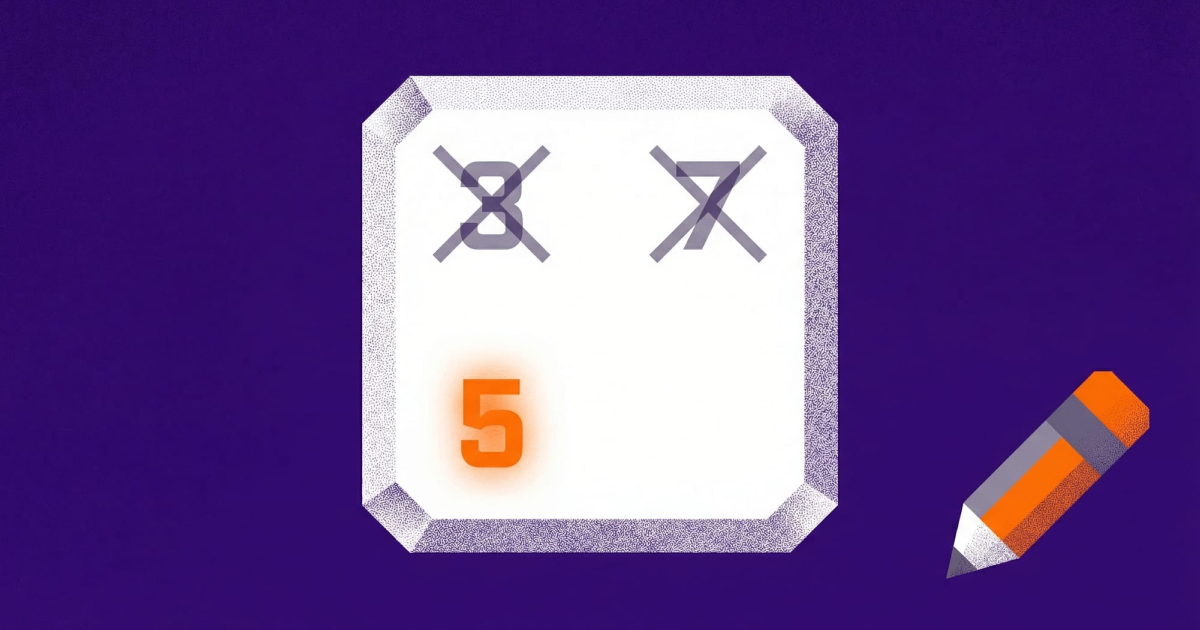
Here is a quick list of some of the best Kakuro techniques for beginners:
The Unique Combinations Shortcut
The most powerful strategy when solving Kakuro puzzles is to memorize or reference unique combinations. As mentioned previously, these unique combinations will provide forced answers, meaning you know with 100% certainty which squares will be contained within a given run. You won’t know their exact placement, but just knowing the values themselves is advantageous to your progression.
Bookmark this Kakuro combinations guide and use it until the patterns become instinctual!
Work Small Before Big
Short runs that contain 2-3 cells are easier to solve than long ones. Start each game by solving as many short runs as you can. Every digit placed within a short run constrains the longer run(s) that overlap with it.
Scan by Digit, Not by Cell
Let's walk through an example puzzle scenario. Say you have a 2-cell run with a clue value of 14.
When looking at the first cell, don’t ask "What goes in this cell?"
Instead, ask yourself, "Where can the (digit) go in this run?"
In this case, you might want to evaluate where 5, 6, 8, or 9 could be placed.
This strategy eliminates candidates faster than guessing the correct values and their cell locations simultaneously.
Never Guess
Kakuro is a pure logic puzzle, which makes guessing counterintuitive to winning.
Every Kakuro puzzle on kakuroconquest.com has exactly one valid solution that can be reached through deduction. If you feel like you need to guess, you've most likely missed a constraint — go back and cross-reference other clues on the board before placing anything.
Common Mistake Check:
Beginner players will often forget that digits can't repeat within a run. It's easy to place a value twice in the same run by accident. Always double check for accidental repeats before progressing!
FAQ
What are Kakuro rules?
Kakuro’s rules are fairly straightforward: players must fill every empty square with a digit between 1 and 9. The black magic blocks at the edges of each run display the target sum and define how many empty squares belong to that run. Each “run” or grouping of cells must add up to the sum shown in the adjacent block. No digit can repeat within the same run, and the number of squares in a run must match the number of cells in said run.
Is Kakuro harder than Sudoku?
As logic puzzles go, Kakuro and Sudoku offer similar levels of difficulty. Kakuro requires both logic and basic arithmetic, which can make it feel harder for beginners. Learning the key combinations makes the Kakuro playing experience much easier.
How many numbers are in Kakuro?
There are 9 playable numbers in Kakuro. The game uses numbers 1 through 9.
Unlike Sudoku, every digit does not need to appear in each row or column. The only numbers that are required to be added are those that correctly sum to match each clue.
How long does it take to learn Kakuro?
Most beginners can solve their first puzzle within 15–30 minutes of learning the rules. The key is memorizing a few unique combinations — once those click, solving speed improves quickly.
The fastest way to speed up the learning curve? Practice solving Kakuro puzzles daily — patterns become instinctual within a week.
The best way to learn how to play Kakuro is simply to start — grab an easy puzzle and follow each step in this guide. Ready to play Kakuro? Start with a free beginner puzzle at KakuroConquest.com.
What does "kakuro" mean?
Kakuro is short for "kasan kurosu," a Japanese phrase meaning "addition cross" — reflecting its crossword grid structure and arithmetic-based gameplay. It was invented in Japan and later popularized worldwide
Where can I play Kakuro online for free?
You can play Kakuro Conquest online for free.
The site offers free daily Kakuro puzzles across multiple difficulty levels, without requiring any form of sign-up.
Kakuro for Beginners: A Recap
Beginners need to remember that Kakuro rewards patience and logic. Make sure to start with beginner puzzles, learn to spot the unique combinations and forced answers, and the rest will follow naturally.
The fastest way to improve is to play daily. kakuroconquest.com has free puzzles at every difficulty level, from 5x5 beginner puzzles to 9x17 grids for experts.
Play Kakuro for free today, or check out our combinations reference guide to give yourself an even better edge.
If you enjoy number-based logic puzzles, Sumplete and Mini Sudoku offer similar daily brain training in a different format
 Mini Crossword
 Midi Crossword
 Diffle
 Killer Sudoku
 Numberle